
In some people, schizophrenia appears suddenly and without warning. But for most, it comes on slowly, with subtle warning signs and a gradual decline in functioning long before the first severe episode. Often, friends or family members will know early on that something is wrong, without knowing exactly what.
In this early phase of schizophrenia, you may seem eccentric, unmotivated, emotionless, and reclusive to others. You may start to isolate yourself, begin neglecting your appearance, say peculiar things, and show a general indifference to life. You may abandon hobbies and activities, and your performance at work or school can deteriorate
The most common early warning signs include:
- Depression, social withdrawal
- Hostility or suspiciousness, extreme reaction to criticism
- Deterioration of personal hygiene
- Flat, expressionless gaze
- Inability to cry or express joy or inappropriate laughter or crying
- Oversleeping or insomnia; forgetful, unable to concentrate
- Odd or irrational statements; strange use of words or way of speaking
While these warning signs can result from a number of problems—not just schizophrenia—they are cause for concern. When out-of-the-ordinary behavior is causing problems in your life or the life of a loved one, seek medical advice. If schizophrenia or another mental problem is the cause, getting treatment early will help.
Symptoms
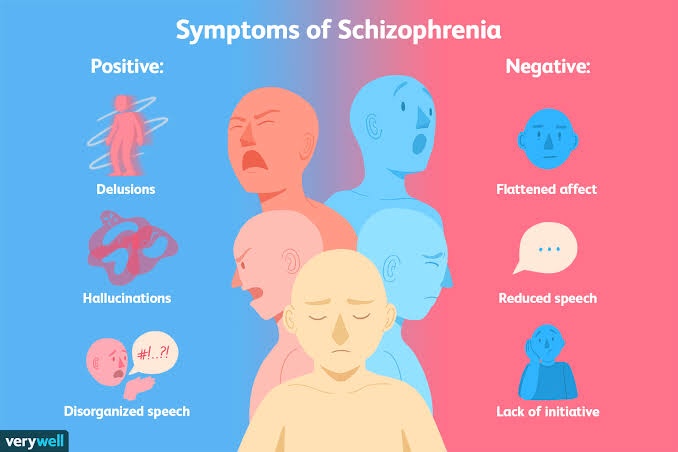
There are five types of symptoms characteristic of schizophrenia: delusions, hallucinations, disorganized speech, disorganized behavior, and the so-called “negative” symptoms. However, the symptoms of schizophrenia vary dramatically from person to person, both in pattern and severity. Not every person with schizophrenia will have all the symptoms, and the symptoms of schizophrenia may also change over time.
Delusions
A delusion is a firmly-held idea that a person has despite clear and obvious evidence that it isn’t true. Delusions are extremely common in schizophrenia, occurring in more than 90% of those who have the disorder. Often, these delusions involve illogical or bizarre ideas or fantasies, such as:
Delusions of persecution – Belief that others, often a vague “they,” are out to get you. These persecutory delusions often involve bizarre ideas and plots (e.g. “Martians are trying to poison me with radioactive particles delivered through my tap water”).
Delusions of reference – A neutral environmental event is believed to have a special and personal meaning. For example, you might believe a billboard or a person on TV is sending a message meant specifically for you.
Delusions of grandeur – Belief that you are a famous or important figure, such as Jesus Christ or Napoleon. Alternately, delusions of grandeur may involve the belief that you have unusual powers, such as the ability to fly.
Delusions of control – Belief that your thoughts or actions are being controlled by outside, alien forces. Common delusions of control include thought broadcasting (“My private thoughts are being transmitted to others”), thought insertion (“Someone is planting thoughts in my head”), and thought withdrawal (“The CIA is robbing me of my thoughts”).
Hallucinations
Hallucinations are sounds or other sensations experienced as real when they exist only in your mind. While hallucinations can involve any of the five senses, auditory hallucinations (e.g. hearing voices or some other sound) are most common in schizophrenia, often occurring when you misinterpret your own inner self-talk as coming from an outside source.
Schizophrenic hallucinations are usually meaningful to you as the person experiencing them. Many times, the voices are those of someone you know, and usually they’re critical, vulgar, or abusive. Visual hallucinations are also relatively common, while all hallucinations tend to be worse when you’re alone.
Disorganized speech
Schizophrenia can cause you to have trouble concentrating and maintaining a train of thought, externally manifesting itself in the way that you speak. You may respond to queries with an unrelated answer, start sentences with one topic and end somewhere completely different, speak incoherently, or say illogical things.
Common signs of disorganized speech include:
Loose associations – Rapidly shifting from topic to topic, with no connection between one thought and the next.
Neologisms – Made-up words or phrases that only have meaning to you.
Perseveration – Repetition of words and statements; saying the same thing over and over.
Clang – Meaningless use of rhyming words (“I said the bread and read the shed and fed Ned at the head”).
Disorganized behavior
Schizophrenia disrupts goal-directed activity, impairing your ability to take care of yourself, your work, and interact with others. Disorganized behavior appears as:
- A decline in overall daily functioning
- Unpredictable or inappropriate emotional responses
- Behaviors that appear bizarre and have no purpose
- Lack of inhibition and impulse control
Negative symptoms (absence of normal behaviors)
The so-called “negative” symptoms of schizophrenia refer to the absence of normal behaviors found in healthy individuals, such as:
Lack of emotional expression – Inexpressive face, including a flat voice, lack of eye contact, and blank or restricted facial expressions.
Lack of interest or enthusiasm – Problems with motivation; lack of self-care.
Seeming lack of interest in the world – Apparent unawareness of the environment; social withdrawal.
Speech difficulties and abnormalities – Inability to carry a conversation; short and sometimes disconnected replies to questions; speaking in a monotone.
(Sourced from helpguide.com)
 SMIS Blog